
Purpose Needs Proof
Purpose becomes practical when it solves a real problem for real people.

I do not want my notes to become a private museum.
That is the trap with learning: you collect ideas, organize them, highlight them, tag them, and still avoid the harder question.
What did this idea change in your actual work?
The useful lesson I pulled from Purpose and Profit is simple:
A technical career becomes stronger when learning turns into useful public proof.
The Old Model
The old model is quiet preparation.
Learn more. Wait for confidence. Keep building in private. Hope that one day the market, an employer, or an audience notices what you know.
That model feels safe because it protects you from judgment.
But it also hides the evidence.
Nobody can evaluate the notes you never turn into a lab, the diagram you never publish, the troubleshooting process you never explain, or the project you never finish.
The Better Model
Purpose becomes useful when it is attached to a problem.
Profit, in the cleanest sense, is not just money. It is feedback from reality. It tells you whether the thing you made helped someone enough to earn attention, trust, opportunity, or payment.
That is why public proof matters.
Public proof is not showing off. It is making your learning visible enough that it can be tested.
For technical people, this can be very simple:
a cloud lab with a diagram
a Linux command explained through a real problem
an automation script with the mistake that taught you the fix
a security checklist based on something you actually built
a short post that turns a confusing concept into a usable mental model
The point is not to look like an expert.
The point is to become useful in public.
Why This Matters More Now
AI made information easier to access.
It did not make judgment easier to prove.
Anyone can ask for a roadmap, summary, command, architecture pattern, or study plan. The difference is what happens after the answer arrives.
Can you test it?
Can you explain the tradeoff?
Can you build a small version?
Can you show where it breaks?
Can you turn the lesson into something another person can reuse?
That is where purpose becomes practical.
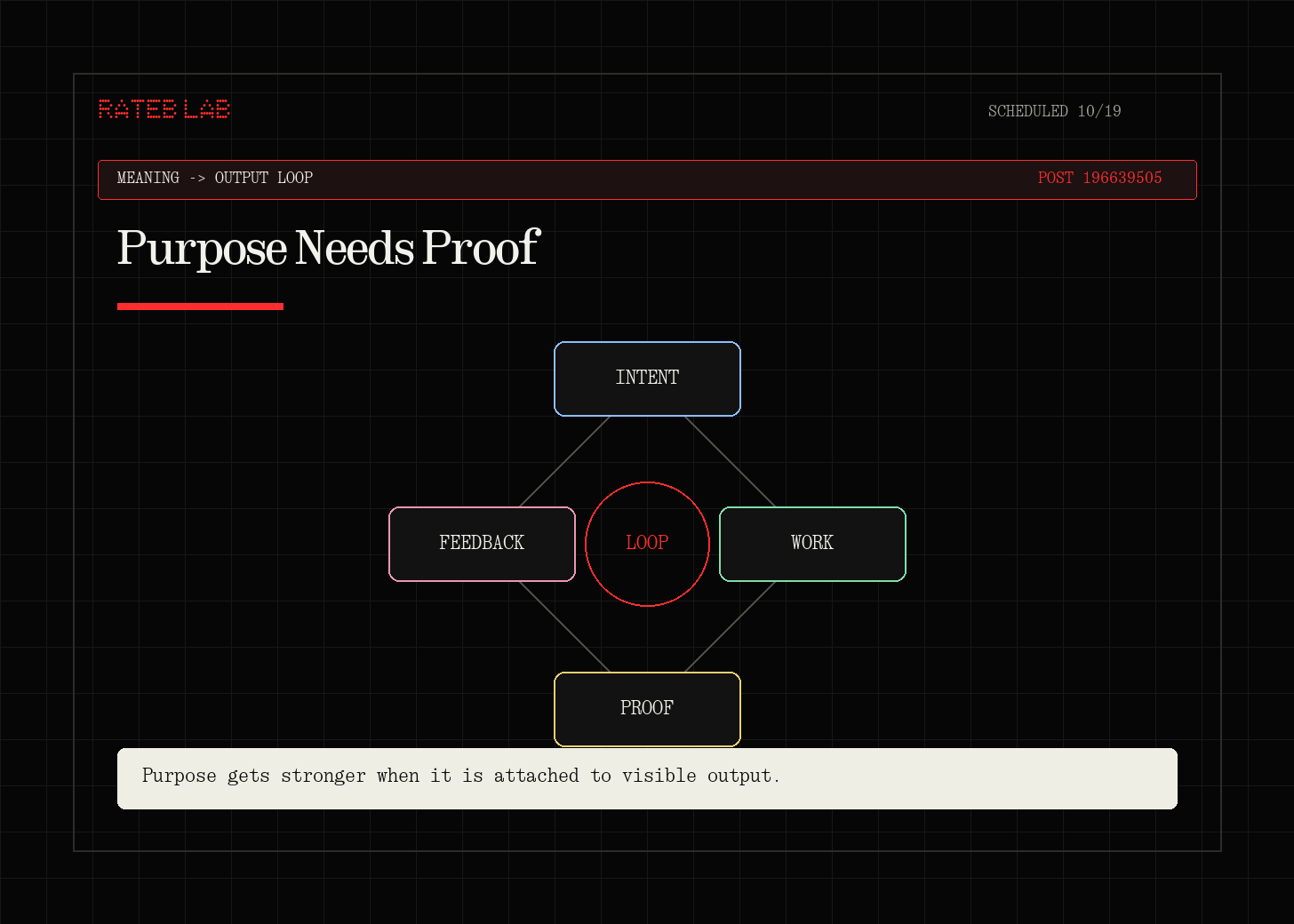
The Public Proof Loop
Here is the loop I am using:
Pick one real problem.
Build or test one small thing.
Write the lesson in plain language.
Share the map publicly.
Let feedback choose the next improvement.
This is how learning compounds.
The note becomes a project.
The project becomes proof.
The proof becomes trust.
The trust becomes opportunity.
A Practical Rule
When I finish a note, I now ask:
What can this become?
Not someday. This week.
Can it become a diagram? A checklist? A small lab? A better question? A short tutorial? A decision I can act on?
If the answer is no, the note is probably unfinished.
Not because every idea needs to become content, but because ideas become stronger when they meet reality.
Try This
Pick one note you already have.
Do not reread the whole thing.
Turn it into one public artifact:
a diagram
a small lab
a public post
a checklist
a decision
a better question
That is the bridge between purpose and profit.
Not branding.
Usefulness.
Source
Inspired by Dan Koe's Purpose and Profit, and my separate study notes from the book.